
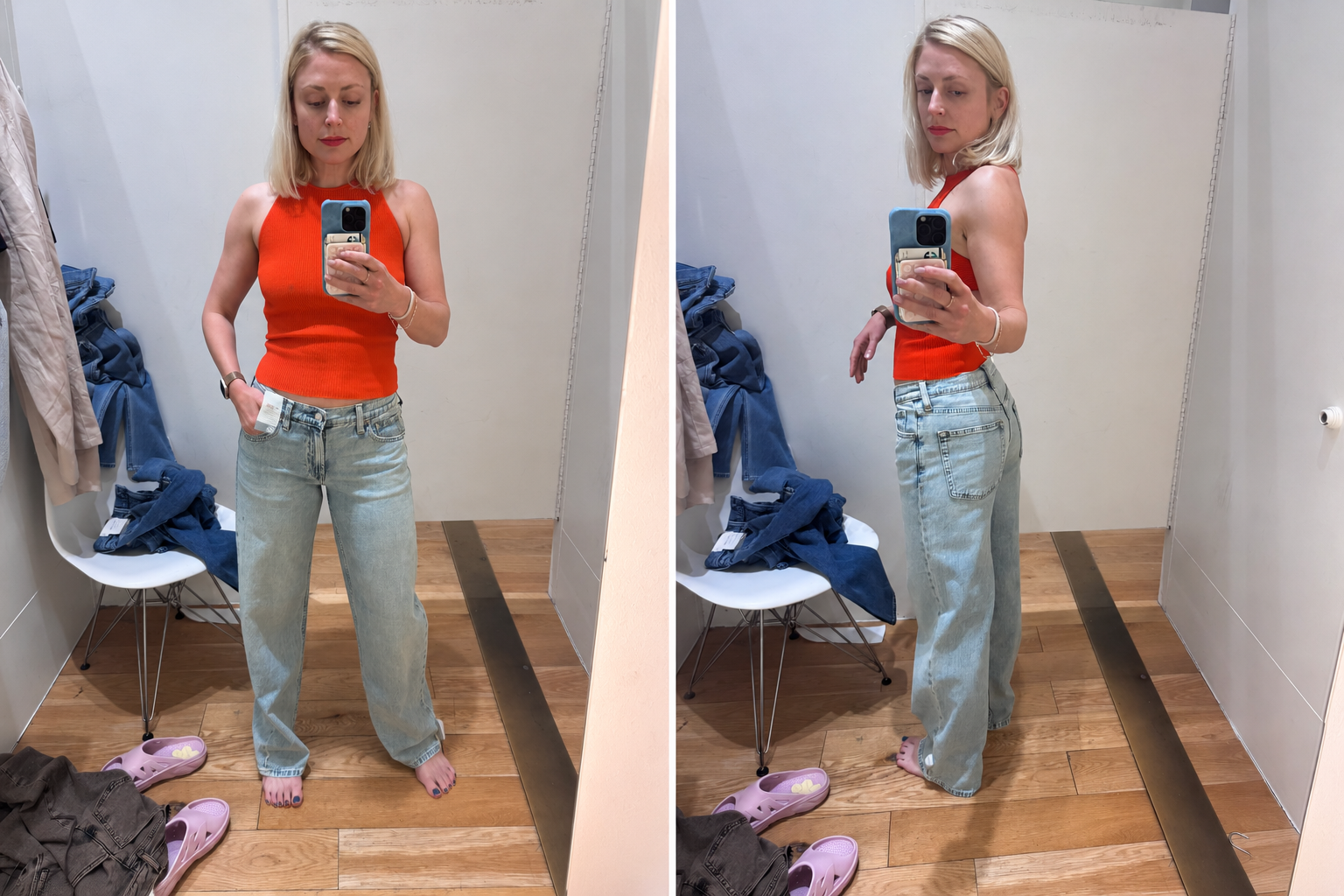
To many a belly-button-shy shopper, 90s and low-slung denim is back.
Gap seems to be at the forefront of the craze, at least from a creative and advertising standpoint, with Zac Posen at the helm. I popped into a store recently to try on this pair I’d been eyeing skeptically for weeks. Admittedly, I somehow have more toned abs than I did in the 90s, so if there was any time in my life to try these, it was NOW (before another decade passes and who knows what happens with my hormones).
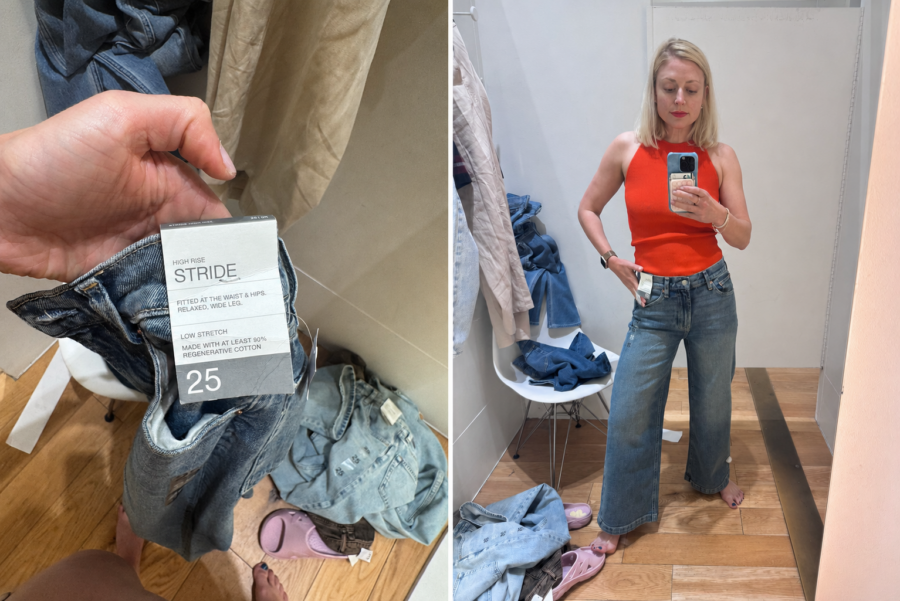
With all this vanity sizing madness, I tried a 24, which felt too tight in-store. And since they didn’t have the next size up available, I ordered the 25 regular online. When they arrived, they fit well. Structured enough. Not overly stretchy. Exactly the kind of jean that tricks you into thinking you’ve finally cracked the code on affordable denim.
I wore them out to a stadium concert with some gal friends, excited to pair them with a zebra-print cami and reclaim the feelings I should have felt in my late teens. I put the jeans through the wringer, traipsing up stairs to get to our nosebleeds, and in just two hours, they had stretched so dramatically I had to use a necktie from my shirt as a makeshift belt to keep my crack from showing. Even the legs turned into parachute pants, and the hems dragged across the concert floor.
One person commented later that night, “Well, those are the jeans you wear if you want to look like you lost 100 pounds…fast.”
After posting about it on IG, a surprising number of people told me they experienced the same thing—not just with this pair, but with a lot of the newer 90s-inspired denim on the market right now.
Which raised a question I couldn’t fully answer myself: Why do some jeans stretch out aggressively while others barely move, even when the fabric composition looks almost identical?
I already knew some broad-stroke answers. For example, I was aware that selvage denim holds up better because of its tighter construction, denser weave, and quality stitching. And I wasn’t expecting mall-brand denim at this price point to behave like Japanese selvage.
However, the massive disparity between the two was perplexing. It seemed to me that the people were missing vital information needed to determine how their jeans would perform off the rack. We’re given a tag with fiber and, if we’re lucky, some origin content. But “99% cotton, made in India” leaves out a lot.
Fabric weight, weave density, finishing processes, yarn construction, and recovery quality—those factors matter just as much, if not more, than the fiber percentage listed on the tag.
So I started digging into what actually causes some jeans to bag out after a few hours while others hold their shape for years. And, more importantly, if the info isn’t listed on the tag…how can you tell before you buy them?
1) Fiber Content Is Only the Headline
That “1% stretch” (usually Elastane) doesn’t tell you nearly as much as brands would like you to think.
Two pairs of jeans can have the exact same fiber composition and behave completely differently because factors like:
- yarn construction
- weave density
- fabric finishing
- stretch distribution
- and elastane quality
All affect how the denim relaxes and recovers after wear.
And, importantly, jeans don’t actually need elastane to stretch.
Even 100% cotton denim will loosen with movement because cotton fibers naturally relax under tension and heat from the body over time. That’s why rigid denim often “breaks in” to your shape after repeated wear.
The difference is how much the fabric relaxes—and whether it recovers afterward.
How to tell in-store
If the jeans contain stretch, you can try a quick recovery test.
The pull-and-release test
- Grab the thigh or hip area
- Pull the fabric outward slightly
- Let go
What you’re looking for:
- If the denim snaps back quickly, recovery is usually better
- If it relaxes slowly or stays slightly stretched, there’s a higher chance it’ll bag out with wear
But here’s the important caveat:
sometimes nothing noticeable happens during this test—and that’s not necessarily bad.
If the fabric feels rigid and barely moves when pulled, it may simply contain very little stretch fiber (or none at all). In that case, the better indicators are:
- fabric weight
- weave density
- and how much the jeans soften as you wear them in the fitting room
Because rigid denim can still relax over time—it just usually does so more gradually and often molds to the body instead of turning into a completely different garment by dinner.
2) Fabric Weight Is a Bigger Deal Than Most People Realize
This ended up being one of the clearest differences between the pairs I tested.
Heavier denim generally holds its shape better. Lightweight denim, especially the softer, drapier varieties popular in a lot of current “90s” cuts, tends to relax much faster.
The issue is that most brands don’t disclose fabric weight clearly, even though it’s one of the most useful indicators of longevity and structure.
So how do you identify it?
Use the hand-feel test
Pick up the jeans.
Do they feel:
- substantial and structured?
- or thin, soft, and almost fluid?
Generally speaking:
- lightweight + soft + drapey = more stretching
- heavier + structured = better shape retention
Try the fold test
Fold one leg over itself.
- If it collapses immediately, it’s likely lightweight denim
- If it holds some structure, the fabric is probably denser and heavier
Ask for the ounce weight
Some brands or associates can actually provide this.
For reference:
- 8–10 oz denim = lightweight
- 11–13 oz = midweight
- 14+ oz = heavier, more rigid denim
Most mass-market brands don’t advertise this prominently, which is unfortunate considering how much it affects performance. If you’re at a higher-end store, you can try asking an associate about the weight.
3) The Fitting Room Test Most People Skip
Trying jeans on while standing perfectly still tells you almost nothing.
Instead:
- sit down
- walk around
- stand back up and check the seat and thighs
If the fabric already starts loosening noticeably after a few minutes, that’s useful information.
Denim rarely gets tighter as the night goes on.
4) Weave Density Matters Too
This is one of those things that becomes easier to spot once you know what you’re looking for.
Look closely at the surface of the denim—especially under good lighting.
A looser weave usually looks:
- slightly more textured
- softer or fuzzier
- less compact
- sometimes almost airy between the threads
The fabric may also feel:
- more flexible
- thinner
- or drapier in your hands
These jeans tend to relax and stretch faster with wear.
A tighter weave, by contrast, looks:
- smoother
- denser
- more compact
- and more uniform across the surface
It often feels sturdier and slightly stiffer at first.
You can sometimes even notice this visually when comparing two pairs side-by-side: one looks almost “flat” and structured, while the other has a softer, more relaxed appearance before you’ve even tried it on.
An easy in-store test:
Hold the denim up slightly toward the light.
You’re not looking for literal holes, but looser weaves often allow a bit more light through and appear less dense overall.
Another trick:
scrunch the fabric in your hand.
- If it immediately collapses into a very soft bundle, the weave is often looser
- If it keeps some structure, the weave is usually denser
This is part of why some rigid jeans break in beautifully over years, while others turn into denim my butt crack situation fast.
5) Low-Rise Jeans Stretch Differently
The rise also matters more than I initially realized.
Low-rise jeans sit lower on the hips, which creates:
- more movement
- more pulling through the seat and thighs
- and more stress on the fabric overall
Higher-rise jeans distribute tension differently because they’re anchored at the waist.
Same fiber content. Completely different wear experience.
6) Be Careful With Ultra-Soft Denim
If jeans feel extremely soft and broken-in when you first try them on, they’ve usually undergone heavier washing or softening treatments.
That can make them more comfortable initially—but it can also mean the fibers are already relaxed before you even wear them.
Translation: they may continue stretching faster than expected.
The Bigger Issue With Denim Labels
Consumers are often expected to predict how denim will wear using incomplete information.
“99% cotton” sounds specific, but it tells you very little about:
- durability
- recovery
- structure
- or long-term fit retention
Meanwhile, the details that actually matter. Fabric weight, weave density, and finishing techniques are rarely communicated clearly.
Which is probably why so many people currently own at least one pair of jeans that becomes unrecognizable by hour three. With these tips, you can hopefully navigate an otherwise dark shopping experience with a bit more ease.
Have other tips? Drop them in the comments.
Looking for sustainable denim brands? Start with our favorites.
PS: I hope you don’t take away from this that all Gap (or budget) jeans will stretch. In some cases, we want that look. And in others, they offer plenty of other heavier-weight and higher- waisted options. And they’re doing great work during their rebirth to bring regeneratively-farmed and organic cotton to the masses! Keep on keeping on, Gap.